

In September, over 1,200 people working across philanthropy and the for-purpose sector gathered in Brisbane/Meanjin for the Philanthropy Australia Conference 2026.
Marking Philanthropy Australia’s 50th year, the conference centred on the theme Mobilising Generosity, Shaping the Future. It asked how Australia could become a more generous nation and how philanthropy might need to change to meet the challenges of tomorrow.
Arts and creativity were woven through the conference program through The Thread, its inaugural arts program. Creative Australia supported The Thread through a partnership with Philanthropy Australia. The program included:
- performances by William Barton; Camerata – Queensland’s Chamber Orchestra; Common People Dance Project; Eagle Junction State School Choir; DJ Martin Green; The Little Red Company; and Ben Graetz as Miss Ellaneous
- poetry from Huda the Goddess and Svetlana Sterlin, presented by Red Room Poetry
- installations by Dead Puppet Society and A Curious Tractor
- artwork by Stolen Generations Survivors, presented by Link-up (QLD)
- visual storytelling from Sketch Group
- a curated bookshop by Brisbane independent bookseller Avid Reader.
Across the conference, five big ideas stood out. Together, they offer the cultural and creative industries useful insights on how to think about and engage with philanthropy.
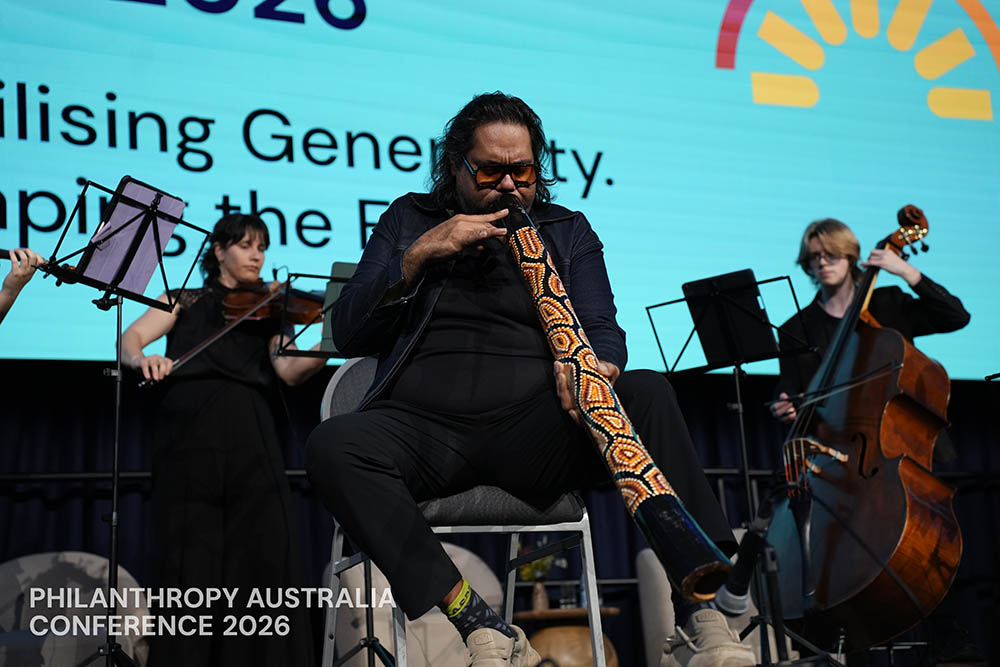
William Barton, widely recognised as one of Australia’s leading didgeridoo players and composers, joined Camerata – Queensland’s Chamber Orchestra for a powerful performance as part of the Philanthropy Australia Conference arts program. Photo courtesy of Philanthropy Australia Conference 2026
1. Generosity grows from belonging
Philanthropy Australia CEO Maree Sidey put one of the conference’s strongest ideas simply: “If we build belonging, we build generosity.”
A briefing on the Charity Aid Foundation (CAF) World Giving Report explored how people give around the world and what shapes generosity. The report measures financial generosity as a proportion of income, which makes it possible to compare giving across countries with very different levels of wealth.
For Australia, the data reveals a giving paradox. Australia is a high-income country, yet Australians gave an average of 0.8% of their income in 2025 – below the global average of 1%. More broadly, the research shows a clear pattern: people in lower-income countries tend to give a larger share of their income compared to people in higher-income countries.
If financial capacity alone does not explain generosity, what else might?
One answer might be belonging.
The World Giving Report found that in countries where more than 80% of people reported a strong sense of belonging to their local community, people gave an average of 1.7% of their income. Meanwhile, in countries where less than 50% reported a strong sense of belonging, people gave an average of 0.6% of their income.
Put another way, people in countries with higher levels of belonging gave nearly three times the share of income compared to countries where levels of belonging were low. The findings show a strong relationship between belonging and generosity, but the report does not go as far as establishing that one causes the other.
This suggests a different starting point for mobilising generosity. Rather than focusing only on how to encourage people to give more, we may first need to consider what kinds of communities, relationships and social norms create generosity in the first place.
For artists and arts and cultural organisations, where creating connection and belonging is often central to the work itself, this relationship between belonging and generosity is particularly relevant.
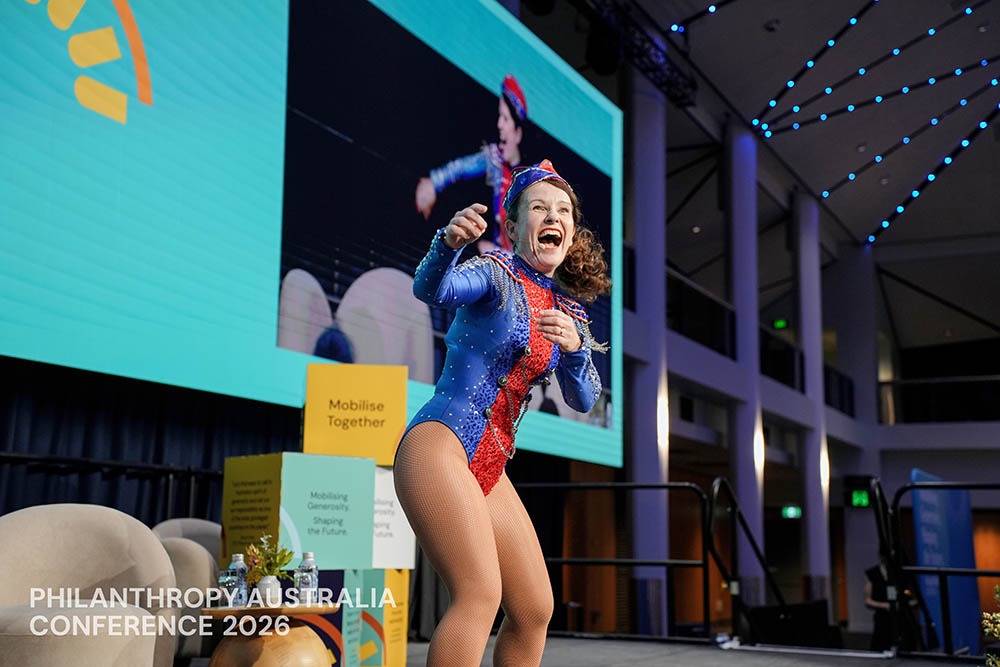
Neridah Waters from Common People Dance Project got conference attendees moving. Common People Dance Project creates joyful, inclusive, participatory dance experiences that bring people together across ages, abilities and backgrounds. Photo courtesy of Philanthropy Australia Conference 2026.
2. Generosity is broader than major gifts and grantmaking
Major gifts and grantmaking are highly visible parts of philanthropy, but conference discussions highlighted a much broader landscape of generosity.
The discussion included remittances and giving within diaspora communities, giving circles, community foundations, and other ways people give through communities and networks. Together, these examples showed that generosity can be organised and expressed in many different ways, through both established philanthropic structures and community relationships.
First Nations speakers broadened the conversation further by framing how generosity itself is understood. They spoke about generosity as a responsibility, grounded in respect, reciprocity and relationships with community and Country, rather than simply as discretionary benevolence.
Together, these perspectives invite a broader view of generosity: not only how much people give or the structures they give through, but where generosity is found, what counts as giving, and how it is understood and practised within communities.
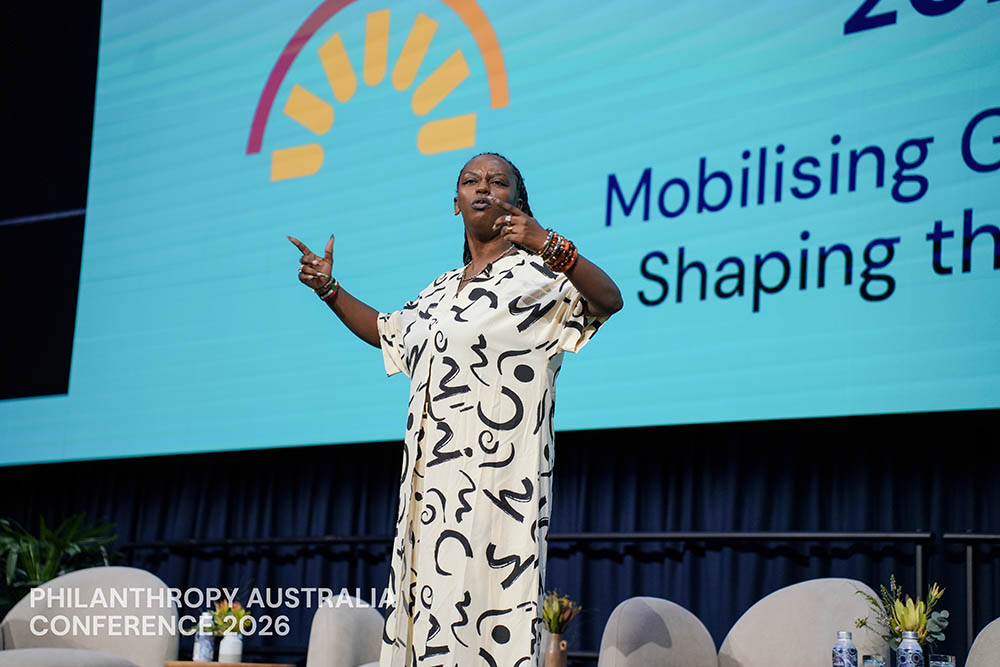
Huda the Goddess is an internationally recognised spoken word poet, educator and activist, renowned for her powerful improvised poetry. She brought her unique blend of artistry, storytelling and social commentary to the Philanthropy Australia Conference. Photo courtesy of Philanthropy Australia Conference 2026.
3. Shaping the future means sharing power
A recurring question of the conference was simple: who has the power?
Speakers questioned approaches that give funders significant control over defining problems, determining solutions and measuring success. Greater emphasis was placed on trust, flexible or unrestricted funding, listening to communities and moving decision-making closer to people with direct experience.
For First Nations communities, this conversation was also about self-determination: supporting community-led approaches and shifting decision-making power to the communities those decisions affect.
The discussion also examined practices that can reinforce funder control, including restrictive funding, burdensome reporting and measurement requirements, low tolerance for risk or an unwillingness to let organisations adapt as circumstances change.
Sharing power, then, is not simply about listening differently. It also requires changing who makes decisions and how funding relationships are structured.
For artists and arts and cultural organisations, these questions of power also apply to fundraising and partnerships: whose priorities shape the relationship, what principles guide it, and who has a seat at the table when decisions are made?
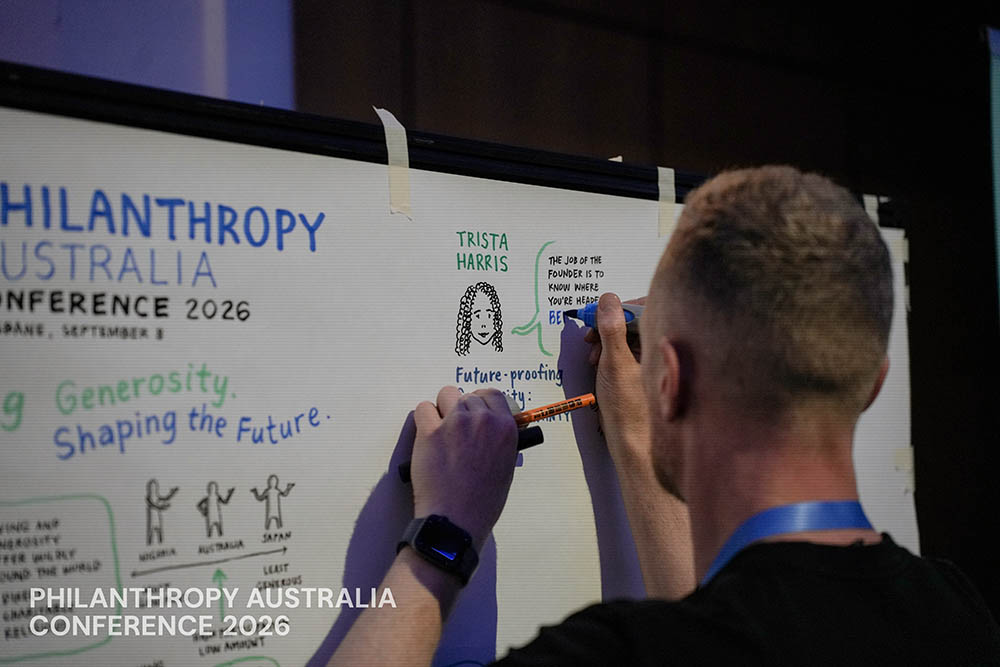
Sketch Group provided visual storytelling throughout the Philanthropy Australia Conference, transforming key conversations and insights into engaging visual records. Photo courtesy of Philanthropy Australia Conference 2026.
4. Shaping the future means thinking long term and acting now
Futurist Trista Harris challenged us to look beyond the usual three- or five-year planning horizon and imagine a 30–50 year future. Her starting point was simple: what are we ultimately trying to leave behind?
A long-term vision does not require a rigid long-term plan. Harris described a dynamic approach, including 12-week sprints followed by deliberate time to reflect, learn and plan the next cycle. This approach, she argues, combines a long-term vision the flexibility to respond as circumstances change.
That long view sat alongside a strong sense of urgency. Discussions about giving while living and spend-down versus perpetuity asked what responsibility exists to act when significant resources and significant challenges are both present now.
Future generations inherit not only the assets we preserve, but also the consequences of the problems we choose not to address. Australia’s intergenerational wealth transfer therefore raises a broader question: beyond the assets changing hands, what kind of future will the next generation inherit?
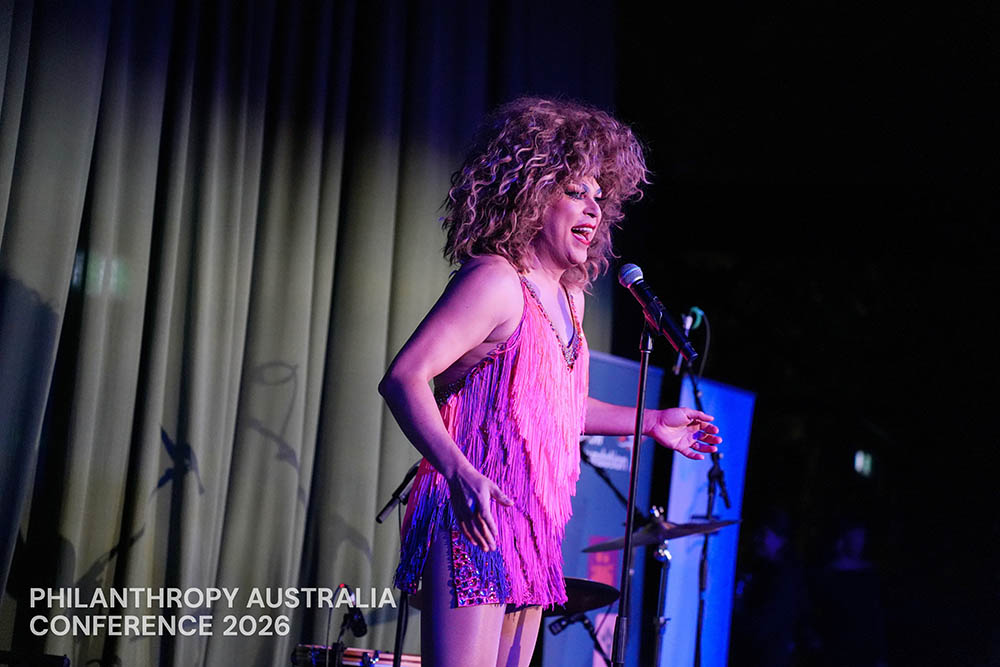
Ben Graetz, the incoming Artistic Director of Darwin Festival, performed as Miss Ellaneous at the conference dinner celebrating the 10th anniversary of marriage equality. Photo courtesy of Philanthropy Australia Conference 2026.>
5. Philanthropy can be a civic actor
The conference also broadened the idea of what philanthropic capital can include. Financial resources clearly matter, but philanthropists and foundations can also contribute:
- relationships and networks
- knowledge and expertise
- reputation and influence
- convening power
- access to decision-makers
- time and capability.
This broader view of philanthropic capital is especially relevant during a period of significant social, political, economic, environmental and technological change globally. Across the conference, speakers returned to many of the forces driving that change, including the rapid development of artificial intelligence, the climate emergency, geopolitical instability, pressure on democratic institutions, political polarisation and anti-rights movements, among others.
In this context, philanthropy can play an important civic role. It can use its resources and influence to shape systems, strengthen democratic and community infrastructure, contribute to public conversations, and support the conditions in which communities can participate and exercise power.
The conference ultimately posed a challenge to philanthropy: how will it use the full range of resources it holds to help shape what comes next?
Matthew Higgins, State Manager Development and Partnerships (QLD)

We acknowledge the many Traditional Custodians of Country throughout Australia and honour their Elders past and present.
We respect their deep enduring connection to their lands, waterways, and surrounding clan groups since time immemorial. We cherish the richness of First Nations peoples’ artistic and cultural expressions. We are privileged to gather on this Country and to share knowledge, culture and art, now and with future generations.
