
In conference with the world
Inside the Australia Pavilion at the Venice Biennale, Lisa Fuller spent part of the European summer leading a team of cultural mediators that helped visitors find their own way into Khaled Sabsabi’s conference of one’s self – and sometimes sent a small piece of it home with them.
It’s a hot summer day in Venice, but entering the shady Australia Pavilion at the 61st International Art Exhibition of La Biennale di Venezia stops many visitors in their tracks. Some pause at the door and ask Lisa Fuller what they’re about to see.
“I would mostly say to them that the work is meant to be experienced before it’s understood,” says Fuller, who finished a 10-week stint as one of the Pavilion’s three attendant managers in late September.
“Go into the space, experience it, sit with it and then we can chat.”
Khaled Sabsabi, 'conference of one's self', 2026, Australia Pavilion. Photo by Andrea Rossetti
Khaled Sabsabi, 'conference of one's self', 2026, Australia Pavilion. Photo by Andrea Rossetti
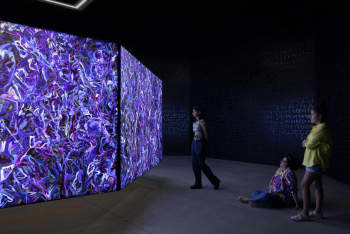
Inside, a suspended octagon of eight landscape canvases hangs in the centre of a similarly shaped, windowless room. Splashed with vivid abstract forms in eight acrylic colours, the paintings are both stationary and motion-filled, as moving images project onto their surfaces and a soundscape ebbs and swells.
This is conference of one’s self by acclaimed multidisciplinary artist Khaled Sabsabi, Australia’s representative with curator Michael Dagostino, at this year’s Biennale.
Sabsabi’s work is at once mesmerising, evocative and easy to lose track of time in. Gratefully, on hand in the dancing light and shadows, is a team of cultural mediators trained to talk with visitors about the work and all that it stirs up.
Khaled Sabsabi and Michael Dagostino, Australia Pavilion, 2026. Photo by Andrea Rossetti
Khaled Sabsabi and Michael Dagostino, Australia Pavilion, 2026. Photo by Andrea Rossetti
“Cultural mediation is about building a relationship with a visitor based around an artwork or arts practice,” Fuller says.
Eight Australians were selected from 149 applicants to Creative Australia’s Cultural Mediation Program – three attendant managers and five pavilion attendants – to work in staggered stints during the six-month Biennale alongside several Italian mediators. All were already working in similar audience engagement roles and most are also artists.
“You need to be into having conversations with strangers. If you love talking to people about art and want to hear what other people bring to the artwork, it’s a fantastic program.”
When not criss-crossing Venice’s famed canals to spend five days a week alongside Sabsabi’s work, Fuller is Gallery Leader at Redcliffe Art Gallery in north Brisbane’s City of Moreton Bay. She’s worked for a decade in public programming and audience engagement, focused on improving access to the arts. It was a change to work as an attendant manager, coordinating Australian and local mediators day to day, looking after the venue and reporting to Creative Australia weekly.
“Normally, I’m working an exhibition changeover every eight to 12 weeks, with multiple artists,” Fuller says. “To take time to sit with one artwork has been quite different.”
Before the Biennale, the mediator team met for three days of training, including time with Sabsabi and Dagostino.
“They were very generous in talking about the artwork and their relationship as curator and artist,” Fuller says.

Lisa Fuller in front of 'conference of one's self'. Photo by Jordan Aczune.
Lisa Fuller in front of 'conference of one's self'. Photo by Jordan Aczune.

Lisa Fuller in front of 'conference of one's self'. Photo by Jordan Aczune.
Lisa Fuller in front of 'conference of one's self'. Photo by Jordan Aczune.

Khaled Sabsabi, conference of one's self, 2026, Australia Pavilion. Photo by Andrea Rossetti
Khaled Sabsabi, conference of one's self, 2026, Australia Pavilion. Photo by Andrea Rossetti

Khaled Sabsabi, conference of one's self, 2026, Australia Pavilion. Photo by Andrea Rossetti
Khaled Sabsabi, conference of one's self, 2026, Australia Pavilion. Photo by Andrea Rossetti

Khaled Sabsabi, 'conference of one's self', 2026, Australia Pavilion. Photo by Andrea Rossetti
Khaled Sabsabi, 'conference of one's self', 2026, Australia Pavilion. Photo by Andrea Rossetti
Fuller also prepared by studying Farīd-al-dīn Aṭṭār’s 12th century Sufi poem, The Conference of the Birds, which influenced Sabsabi’s work. In it, a flock of birds crosses seven valleys to hunt for their divine guide, only to find what they were seeking was themselves.
Sabsabi added an eighth valley. For him, eight signifies a point of transformation and self-completion, and the number is everywhere here: eight canvases, eight projectors, eight walls, eight paint colours.
But Fuller never led with any of this when she approached visitors.
“I’d say 95% of people see botanical-like flowers or forests,” she says.
Others saw Monet’s waterlilies, cells under a microscope, cross-sections of a human brain or even a 1990s Magic Eye picture.
“The human brain is so calibrated to pattern recognition that they try to make sense of something that’s very abstract.”
In fact, the projected images are distorted footage of Western Sydney football crowds: thousands gathered and cheering in a representation of collectivity, belonging and multicultural Australia.
“When you actually unpack the footage, it’s a surprise to many people,” Fuller says of the moment the crowd’s hands, faces and bodies come into focus.
"With cultural mediation, their interpretation isn’t wrong. You might be able to enlighten them further about a process or the inspiration, but what they see is what they see; that’s a genuine interpretation of the artwork.”
Time also changes the view. As eyes adjust, the black octagonal walls reveal glossy stencilled Arabic letters, numbers and symbols. They’re not readable text, but a talisman Sabsabi created to protect visitors and the energy of the space.
Few visitors recognise the script as Arabic, and some, Fuller says, are surprised to find it in the Australia Pavilion. That gave the mediators an opening to talk about Sabsabi’s own story: in 1976 his family fled Lebanon’s civil war and came to Australia.
Despite her thorough preparation, Fuller is candid about the limits of her knowledge.
“You’re allowed to not know all the answers. But to be able to meet someone with a greater depth of knowledge or who’s familiar with the poem has led to some of the best conversations.”
Ten weeks with conference of one’s self changed her own view of it too.
“My relationship with the artwork was able to evolve in a dynamic way, depending on my mood, the time I spent with the work and what I was able to take from visitors – their reactions and experiences.”
Venice was an intense and far more sociable experience than she expected as well.
“I really underestimated how much socialising and networking was involved in meeting people from around the world doing similar work for their own pavilions,” she says.
She also met Australian arts workers visiting through Creative Australia’s Biennale Delegates Program and the launch of the exhibition’s companion publication.
Mediators also play a part in the invitation – an exhibition within the exhibition, of sorts. Roughly every 1000 visitors, Fuller and her colleagues have invited someone to take home one of 400 small boxed acrylic works by Sabsabi and care for it for eight years. At that point, it’s planned that the works will reunite for an exhibition in Sydney. In the meantime, they can be tracked via a geolocated website.
Khaled Sabsabi, conference of one's self, 2026, Australia Pavilion. Photo by Andrea Rossetti
Khaled Sabsabi, conference of one's self, 2026, Australia Pavilion. Photo by Andrea Rossetti
Some potential custodians are enthusiastic, others are daunted and not everyone accepts. Some older visitors decline, unsure if they’ll be around in eight years.
“Having a promise between two strangers is quite an intense, unusual concept. Some people are brought to tears, to be trusted with that process from the artist.”
Fuller’s final invitation was to an American who had read Sufi texts and visited Australia.
I thought, ‘She’s absolutely the right person,’ so I navigated the conversation to the invitation,” Fuller says.
The woman was so moved that she gave Fuller a silk scarf from an American art project in return.
“There was this really beautiful moment of feeling like it was the right person at the right time,” she says. “There’s probably not enough generosity in the world at the moment; it feels so strange to just be given something without any real strings attached.”
The 61st International Art Exhibition of La Biennale di Venezia runs until Sunday 22 November 2026 in Venice, Italy.
Khaled Sabsabi’s work conference of one’s self, curated by Michael Dagostino and commissioned by Creative Australia, can be seen in the Australia Pavilion, while his companion work khalil, is presented as part of La Biennale di Venezia’s In Minor Keys at the event’s Arsenale venue.
 Built with Shorthand

We acknowledge the many Traditional Custodians of Country throughout Australia and honour their Elders past and present.
We respect their deep enduring connection to their lands, waterways, and surrounding clan groups since time immemorial. We cherish the richness of First Nations peoples’ artistic and cultural expressions. We are privileged to gather on this Country and to share knowledge, culture and art, now and with future generations.
