

Dozens of people gather in a loose circle. Some crouch, slapping their hands on the floor. Others stand, tapping their feet, shaking their hands in the air, or nodding their heads to a pulsing musical beat.
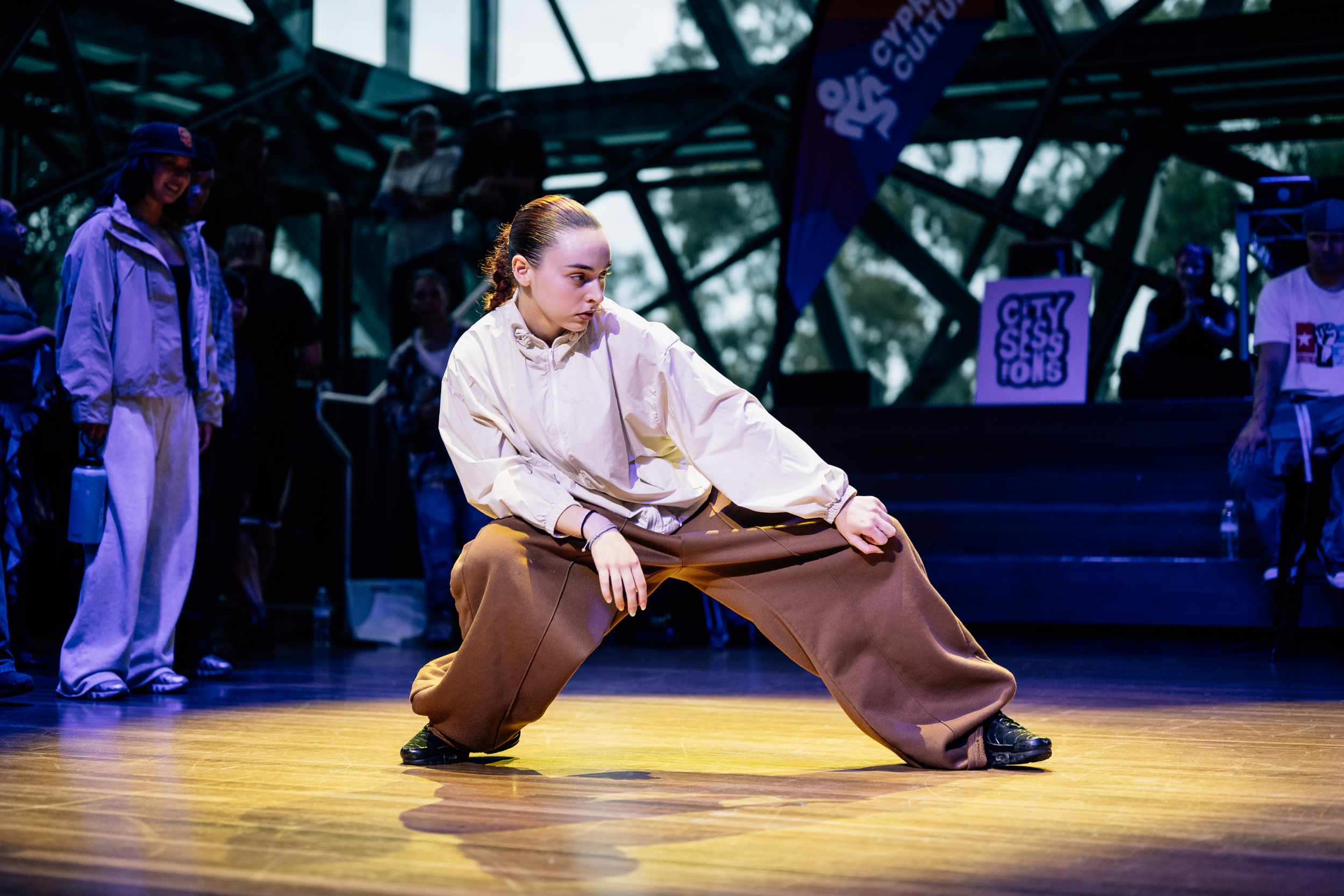
At the centre of the circle, with scores of eyes fixed on them, a body moves in rhythm to the music, alternating between smooth, gliding twists and sharp, angular contortions. They suddenly flip into a one-armed handstand, kick their legs in the air and drop into a spin on their back on the polished floor. The crowd cheers, claps, clicks their fingers in appreciation.
It’s unpredictable. It’s mesmerising. It’s a street dance battle.
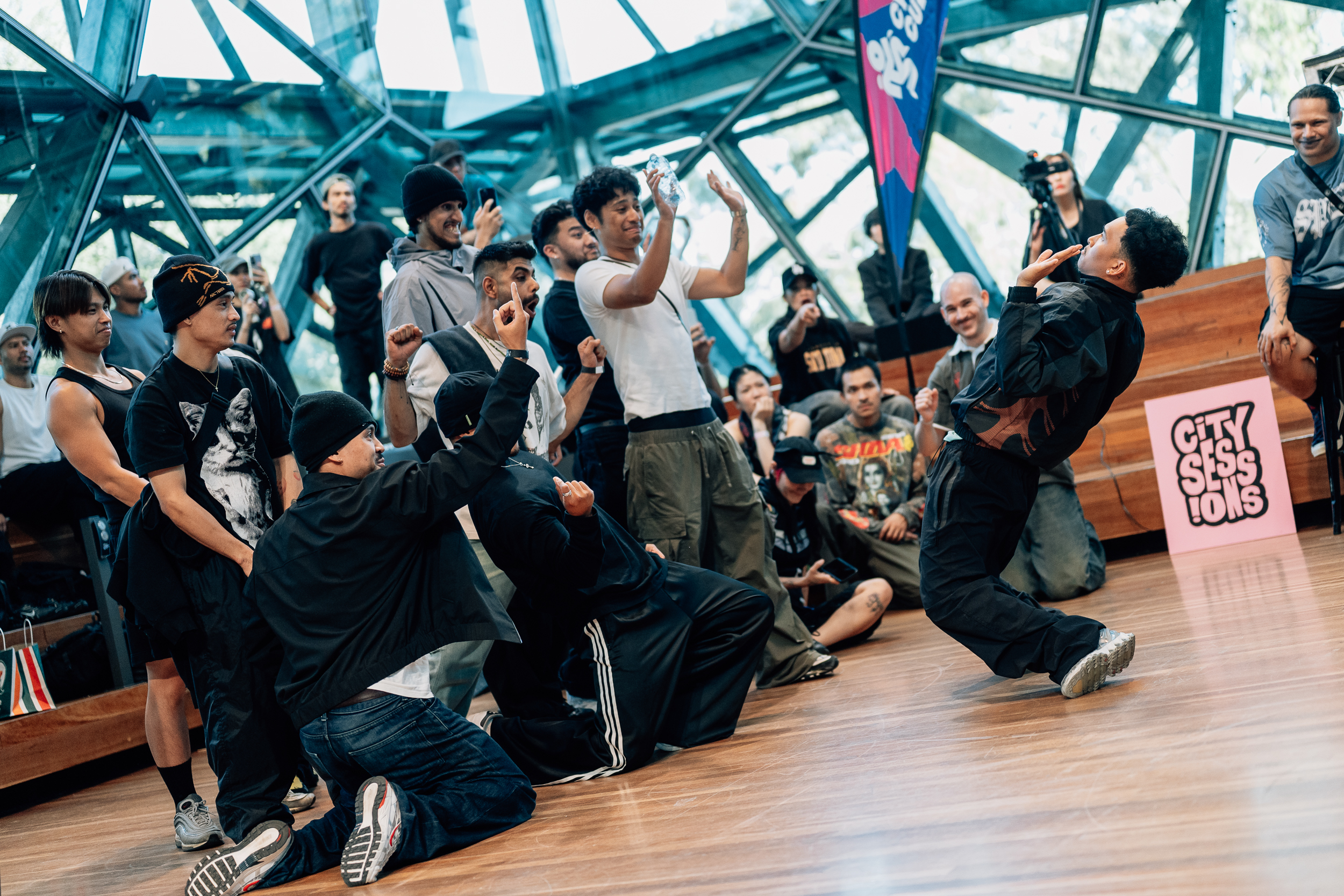
“When I found Hip Hop, it was my saviour,” says breaker Demi Sorono. "It changed my whole entire life.”
Unlike many of the more traditional dance practices, ‘street dance’ – a collective term for forms and styles including Hip Hop, Breaking, Popping, House, Waacking, Vogue and even the locally born Flooding – has long lived out of the spotlight of mainstream arts and cultural spaces.
But a new national report is setting out to change that.
Street Dance in Focus: Practices, communities and futures in Australia is the first national survey of Australia’s street dance community. Led by researcher Dr Jason Ng and produced in partnership between Creative Australia and Cypher Culture, a Naarm/Melbourne-based street dance community organisation, the report draws on nationwide survey data from 471 dancers and interviews with artists.
For Ng, who’s also a music producer and b-boy – short for ‘breaker’ or break dancer – the project addresses a longstanding gap.
“We never had a way to talk about or evidence our practice as artists, as communities, as event makers, as producers,” he says. “It was always very difficult to showcase the value of street dance and how big its reach is and how much impact it has.”
The data reveals a community that’s young and diverse. 49% of respondents are 25–34. 33% are 18–24. Women represent 54% of the community – rising to 63% among 18–24-year-olds. Strikingly, 64% identify as culturally and linguistically diverse. 42% were born outside Australia.

Street dancers are also highly engaged in the arts broadly, with 89% attending arts and creative activities beyond street dance.
People play multiple roles within the community: 49% are performers, 33% teach street dance and 23% work as event producers or managers.
“It shows street dance as a cultural ecosystem, not just a performance outcome,” says Geoffrey Lim, executive director of Cypher Culture and a street dancer for more than 20 years.
That richness sits alongside real challenges.
“Once you hit a certain amount of understanding and skill within dance, you would consider yourself as professional,” says Efren Pamilacan, Cypher Culture’s artistic director and a dance maker and independent producer. But the difficulty for many dancers is earning a living off their art.
Just 35% of respondents engage in paid work related to street dance, most working five hours or less a week, with 85% freelance or self-employed.
“The hustle to be a full-time dancer is real. Not having the resources or the access or the knowledge of how to promote myself as an artist, I think that hindered my opportunities,” Sorono says.
“I have a plethora of jobs when, if I can’t have a stable income with dancing, I’d have to find other means of trying to develop different skills so that I can support myself financially … we have to thrive to survive.”
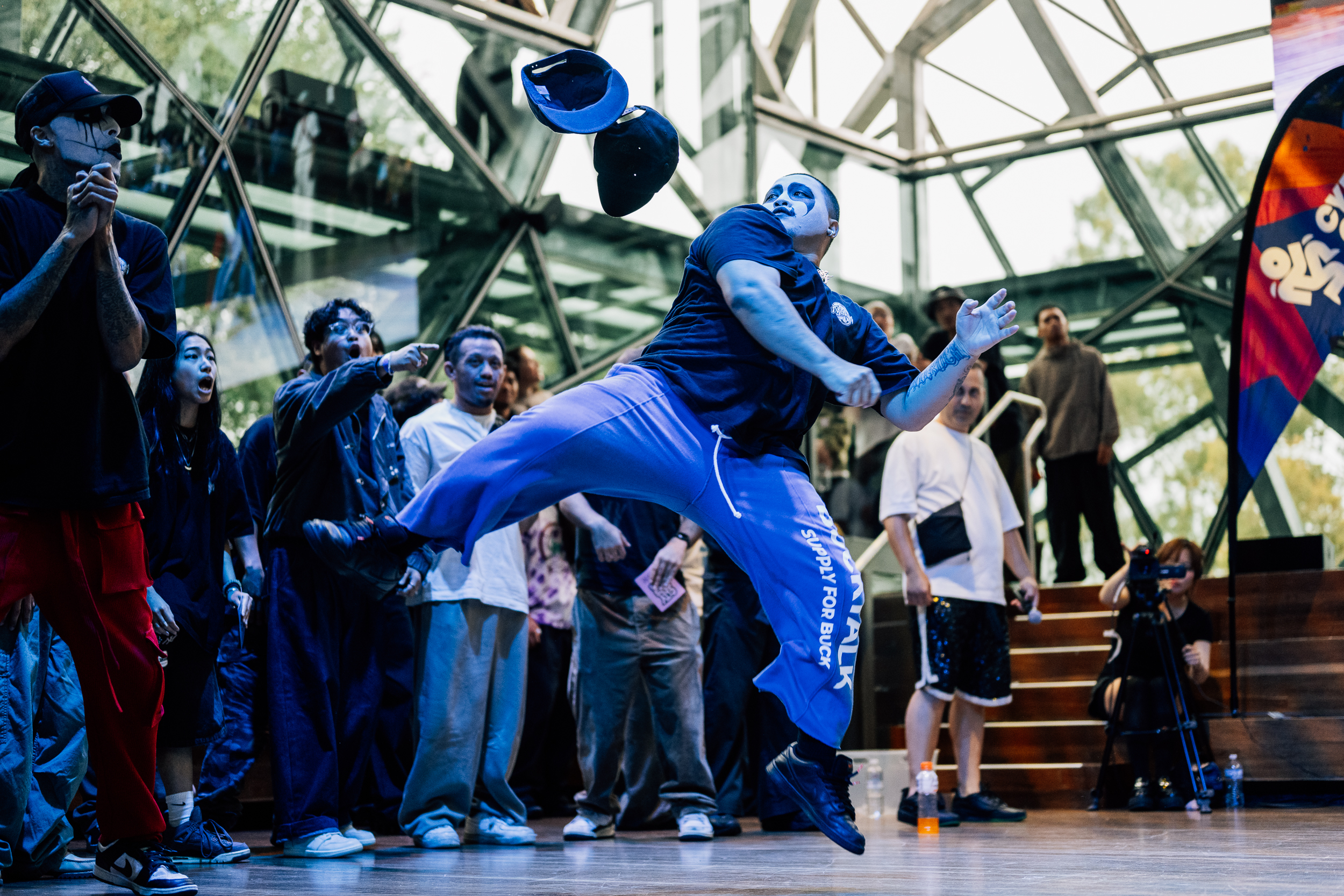
Three quarters of respondents want to spend more time on their professional practice but are held back by insufficient income and a lack of performance opportunities. Only 21% have ever applied for government financial assistance.
Most dancers train every two to three days (44%), primarily in public spaces (76%) or at home (73%) – not in formal studios – and 93% train at night. Despite this commitment, 60% of respondents say the lack of accessible spots to practise nearby is a major barrier.
This kind of data makes Street Dance in Focus a powerful tool for change.
“In the past, when I’m writing a grant application and they say, ‘Who are you? Why do you matter?’ I’m just speaking anecdotally,” Lim says.
“When you’re talking to policymakers or funding bodies, it makes it a lot easier to speak their language, especially in a world of data-driven decision making.”
Lim is already using the report in city infrastructure planning advocacy, pointing to its potential to solve issues such as activating public spaces at night and engaging disaffected communities in new ways.
“We can point to other research that says these are the target demographics that governments struggle to reach, but we’re here and there’s so many of us now,” he says.
“I’ve been pushing and advocating for street dance in public spaces. And if we get displaced from a place, a place isn’t allocated to us, we won’t have a space to train or for a community to exist.”
The reality is different in regional Australia. For Maxwell Douglas – based in Ipswich, Queensland, and known in the community as ‘ThvFlood’ – access to the artform meant an hour-long train commute to Brisbane for years, to find a dance scene that was limited at home.
“My experience [with grassroots] is that the grass can only grow so high,” he says. “There's only so far you can go. And that can hurt the communities a lot. We have to self-create our own ecosystem.”
That isolation can also be generative. Following devastating Queensland floods in 2011, Douglas developed ‘Flood’ or ‘Flooding’ – now recognised as Australia’s first locally originated street dance form, which is gaining international recognition.
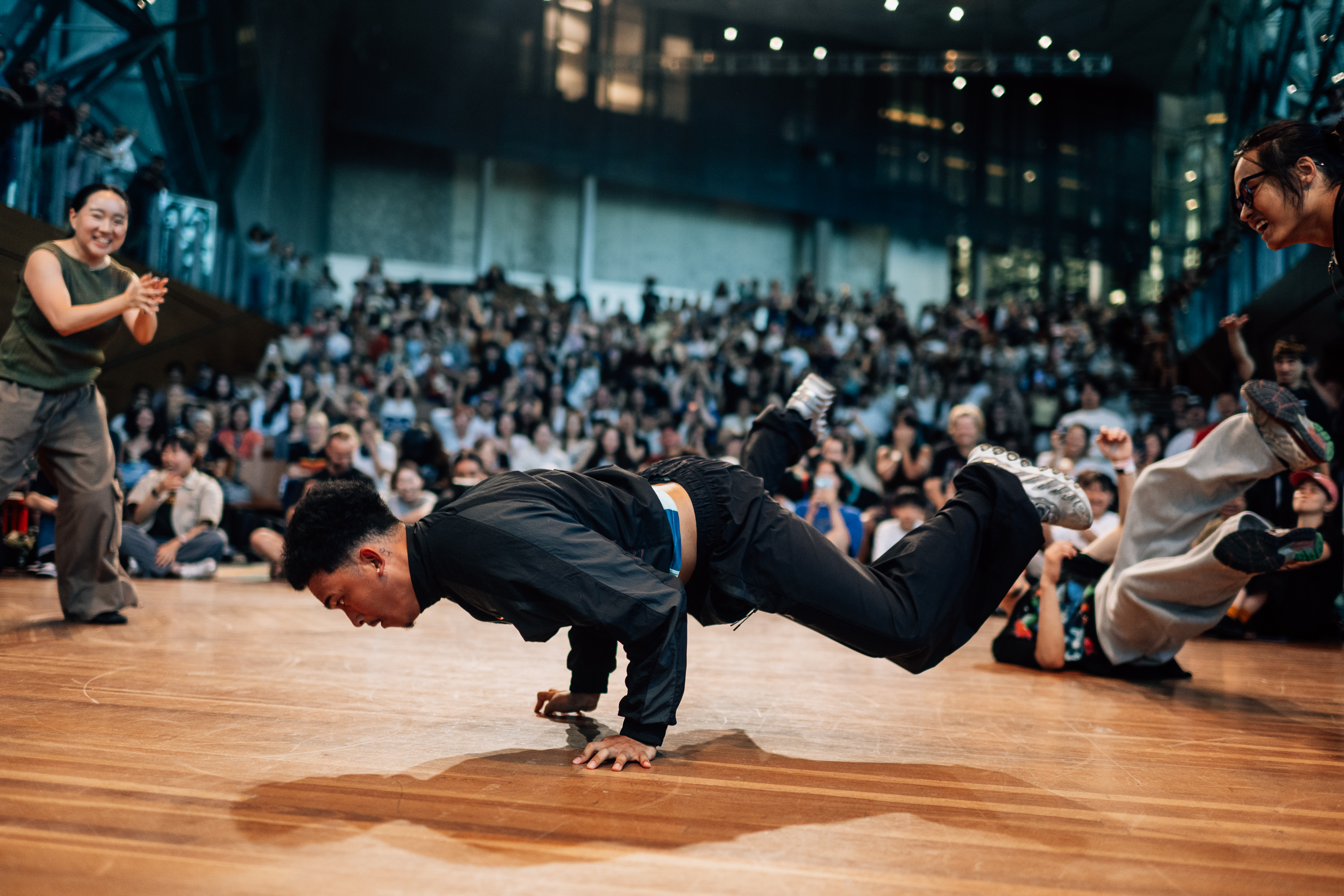
“We’ve got stories to tell. We’ve got things here that are very valuable. And art is a way to translate that,” he says of a locally created dance form.
“I feel like it’s a connection to country, a connection to the people in that area … being proud of where you’re from and who your mates are, where you grew up.”
Street dance has always created something extraordinary from nothing – from garages and living rooms to city laneways and plazas. With Street Dance in Focus, when the music starts, Australia's street dance community will be ready with the power of data added to its dance repertoire.
“The seeds are planted,” Douglas says. “How much can we nurture it to really bloom and then enjoy the fruits of that for the next generation?”
The full Street Dance in Focus report is available to explore now. You can also sign up to receive updates from Cypher Culture about upcoming works, activities and research.

We acknowledge the many Traditional Custodians of Country throughout Australia and honour their Elders past and present.
We respect their deep enduring connection to their lands, waterways, and surrounding clan groups since time immemorial. We cherish the richness of First Nations peoples’ artistic and cultural expressions. We are privileged to gather on this Country and to share knowledge, culture and art, now and with future generations.
